
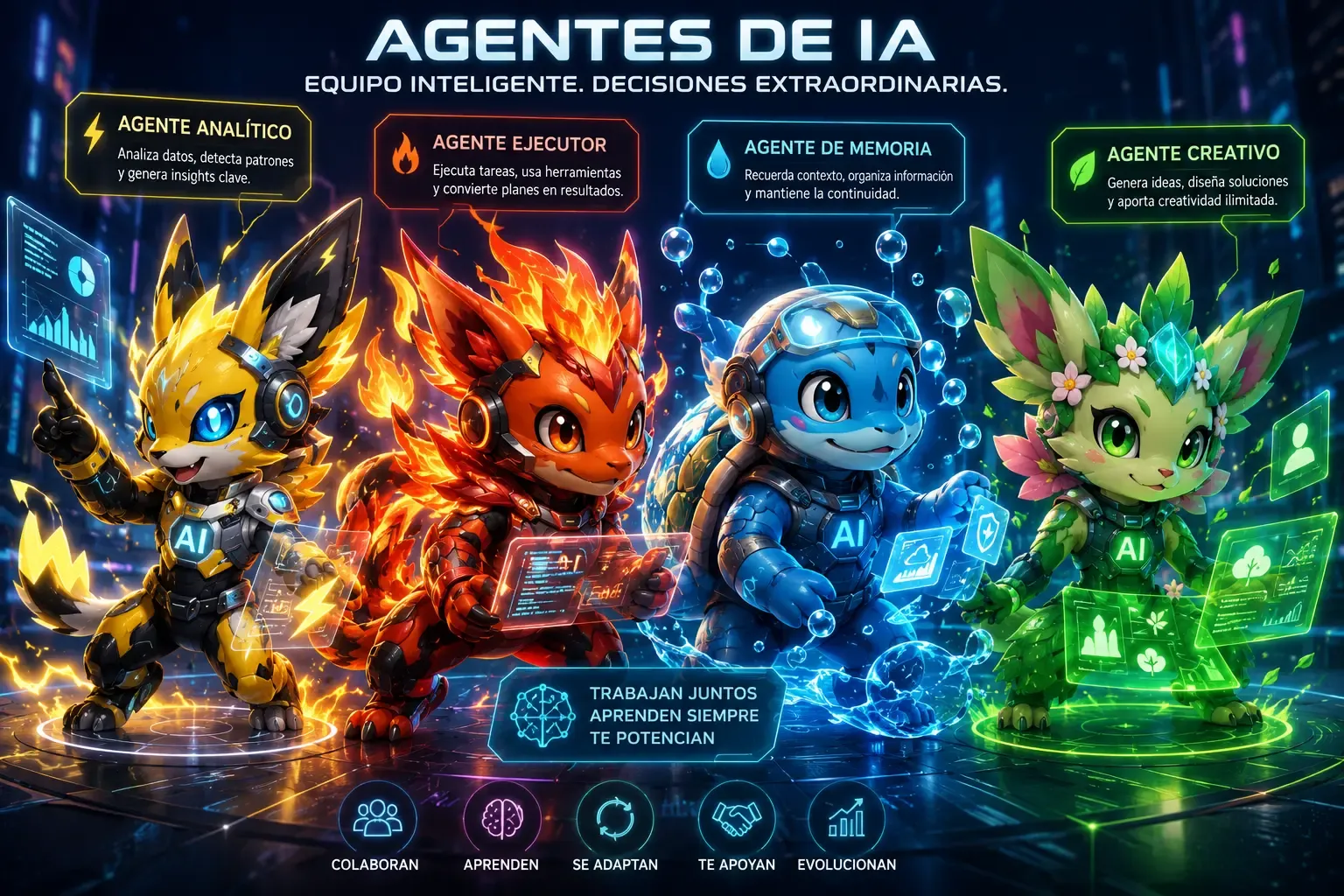
Artificial intelligence is entering a new stage. For years, most AI systems were designed to answer questions, classify information, or generate text. But now the focus is shifting toward AI agents: systems capable of observing an environment, making decisions, learning from experience, using tools, and collaborating with other agents to achieve goals.
Interestingly, one of the best metaphors for understanding how these agents should evolve does not come from a research lab, but from the world of Pokémon.
Although Pokémon was born as a video game, its structure contains surprisingly useful ideas for thinking about the future of AI: specialization, training, evolution, teamwork, memory, adaptation to the environment, and strategic decision-making. If we look at Pokémon as conceptual models, we can imagine a new generation of AI agents that are more flexible, personalized, and collaborative.
1. Every Agent Needs a Specialty
In Pokémon, not every character serves the same purpose. Pikachu stands out for its electric attacks. Squirtle masters water. Bulbasaur combines grass and poison. Charizard can fly and breathe fire. Each Pokémon has strengths, weaknesses, and contexts where it performs best.
AI agents could work in a similar way.
Instead of building one giant agent that tries to do everything, we could design ecosystems of specialized agents. One agent could be responsible for researching information. Another could summarize documents. Another could write code. Another could negotiate calendars. Another could review legal or financial risks.
The key would not be to create a “universal” AI, but a team of agents with different abilities, just like a Pokémon trainer builds a team according to the challenge they are facing.
2. Training Matters More Than Raw Power
In Pokémon, a character does not become strong simply by existing. It needs training, experience, battles, items, strategy, and direction. Two Pokémon of the same species can end up being very different depending on how they were trained.
This offers an important lesson for AI: an agent’s performance does not depend only on the base model, but also on its operational training.
A useful AI agent needs:
* clear instructions;
* relevant memory;
* access to tools;
* feedback;
* action limits;
* experience with real tasks;
* criteria for knowing when to ask for help.
Just as a poorly trained Pokémon can waste its potential, a poorly configured AI agent can fail even if it is built on a powerful model.
3. Evolution as Progressive Improvement
One of the most iconic elements of Pokémon is evolution. A Pokémon can transform into a stronger, more complex version with new abilities. Charmander becomes Charmeleon, and then Charizard. Magikarp, seemingly useless at first, can become Gyarados.
This idea fits very well with the development of AI agents.
An agent should not be static. It should be able to improve over time. At first, it might execute simple tasks. Then, as it accumulates experience and receives corrections, it could learn better procedures, recognize patterns, optimize decisions, and handle more complex cases.
The evolution of an agent does not necessarily have to mean that it “changes models.” It can also mean that it improves its instructions, updates its memory, learns better workflows, acquires new tools, or integrates with other systems.
In other words: an AI agent should be able to go from “Charmander” to “Charizard.”
4. Pokémon Types Teach Modular Architecture
The type system in Pokémon — water, fire, grass, electric, psychic, ghost, steel, dragon, and so on — creates a logic of interaction. Water is strong against fire. Fire is strong against grass. Electricity is strong against water. Each type has advantages and vulnerabilities.
This can inspire a modular architecture for AI agents.
We could imagine “types” of agents:
Analytical agents, good at data and quantitative reasoning.
Creative agents, good at generating ideas, narratives, or designs.
Executor agents, good at using tools and completing tasks.
Critical agents, good at detecting errors, risks, and contradictions.
Social agents, good at communicating with humans, coordinating teams, or adapting tone.
Memory agents, good at remembering historical context and preferences.
Just as a balanced Pokémon team needs type diversity, an advanced AI system will need functional diversity. Intelligence will not only be individual, but collective.
5. Weaknesses Are Part of the Design
In Pokémon, even the most powerful characters have weaknesses. A fire Pokémon can be vulnerable to water. A psychic Pokémon can struggle against certain dark types. This is not a flaw in the system: it is what makes the game strategic.
AI agents also need explicit weaknesses.
A common mistake is designing agents as if they should be safe, perfect, and autonomous at all times. But that can be dangerous. A good agent must know what it cannot do. It must recognize uncertainty, ask for confirmation, delegate tasks, and stop when the risk is high.
Instead of hiding limitations, we should design them as part of the architecture.
A medical agent should not make legal decisions. A financial agent should not execute transactions without authorization. A programming agent should not modify critical systems without review. Just like in Pokémon, knowing the weaknesses makes it possible to create better strategies.
6. The Human-Agent Relationship Resembles That of a Trainer and Pokémon
In Pokémon, the trainer does not control absolutely everything. The trainer chooses the team, defines the strategy, decides when to switch Pokémon, and when to use certain moves. But each Pokémon has its own abilities and personality within the system.
This relationship can help us think about the interaction between humans and AI agents.
The human should not have to make every micro-decision. But they should not disappear from the process either. The user acts as the trainer: defining objectives, setting limits, selecting tools, correcting mistakes, and deciding when to trust or intervene.
The agent, in turn, executes, proposes, learns, and adapts.
The future of AI will not necessarily be “humans replaced by agents,” but humans coordinating teams of agents, like trainers who know when to use each member of their team.
7. Moves Are Like Tools
Each Pokémon has specific moves: Thunder Shock, Flamethrower, Surf, Ice Beam, Recover, Protect. Having high stats is not enough; the move set determines what it can actually do in practice.
In AI, “moves” are equivalent to tools.
An agent can have access to search engines, databases, calendars, code editors, spreadsheets, APIs, email, internal documents, or automation systems. Its usefulness depends on which tools it can use and when it decides to use them.
An agent without tools is like a Pokémon with few moves: it may have potential, but its practical capability is limited.
True operational intelligence emerges when the agent knows how to choose the right move at the right time.
8. The Pokédex Anticipates Contextual Memory
The Pokédex records information about each Pokémon: characteristics, behaviors, habitats, evolutions, and useful data. It functions as a structured memory of the world.
AI agents also need something similar: organized contextual memory.
It is not enough for an agent to “remember everything.” It must remember what is relevant: user preferences, previous decisions, corrected mistakes, long-term goals, constraints, relationships between projects, and environmental context.
A well-designed memory turns a generic agent into a personalized agent.
Without memory, every interaction starts from zero. With memory, the agent can behave more like a long-term companion.
9. Battles Teach Learning Through Feedback
In Pokémon, every battle produces information. The player learns which attacks work, which combinations fail, and which strategy should be adjusted. Experience is not abstract: it is gained by interacting with the environment.
AI agents should also improve through feedback loops.
An agent can propose a solution, receive evaluation, correct its approach, and update its procedure. This creates a form of operational learning, not necessarily at the level of massive model training, but at the level of behavior, memory, and strategy.
Human feedback is essential. Without it, the agent may repeat mistakes. With it, the agent can develop better habits.
10. The Future Could Be an Ecosystem of Agents
The greatest lesson from Pokémon is not that a single character is powerful. It is that the entire system works as an ecosystem.
There are trainers, teams, types, regions, items, gyms, evolution, trading, cooperation, and competition. Each element contributes something to the whole.
AI could move in the same direction: not toward one all-powerful agent, but toward ecosystems of specialized agents that collaborate under human supervision.
A user could have a “team” of agents: one for research, another for creativity, another for operations, another for personal finance, another for organizational health, and another for learning. Each agent would have its own abilities, tools, limits, and memory.
The question would no longer be “What can an AI do?” but “What AI team do I need for this goal?”
Conclusion
Pokémon may seem like a light reference, but it offers a powerful metaphor for thinking about the design of AI agents. It reminds us that intelligence does not depend only on brute force, but on specialization, training, evolution, strategy, memory, and collaboration.
The best AI agents will probably not be isolated systems that try to do everything. They will be specialized, trainable, adaptive, and coordinated entities capable of working as a team under human direction.
In that sense, the future of artificial intelligence could look less like a lonely supercomputer and more like a Pokémon adventure: choosing your team wisely, training it patiently, understanding its limits, and using the right strategy for each challenge.