
AI Does Not Fail Because of a Lack of Technology. It Fails Because of a Lack of Direction.
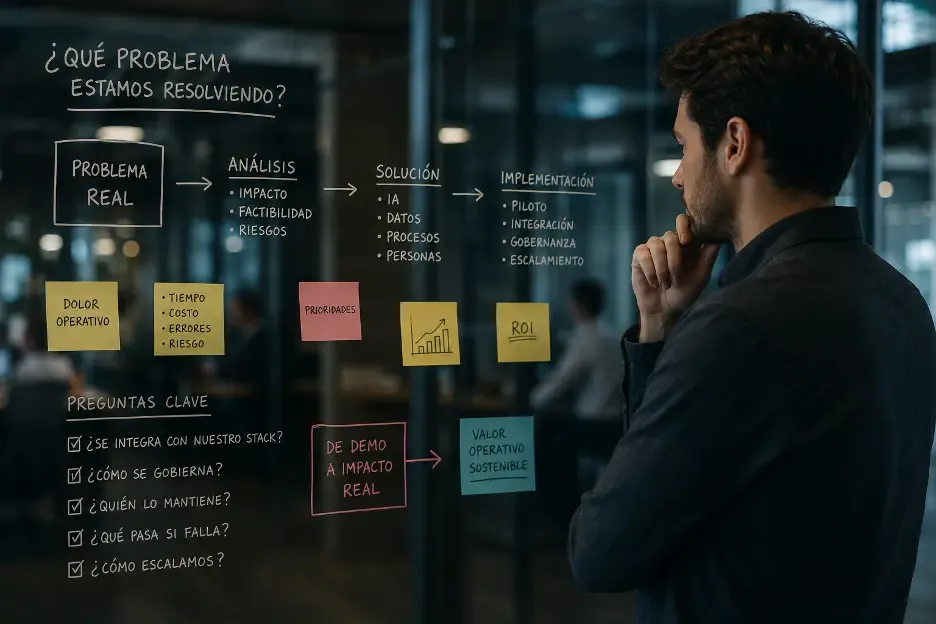
Many organizations are confusing speed with direction in their AI adoption journey. The real challenge is not building impressive demos, but designing systems that can integrate with real operations, meet governance requirements, scale sustainably, and generate operational ROI.
AI Does Not Fail Because of a Lack of Technology. It Fails Because of a Lack of Direction.
Over the past 18 months, I have had conversations with banks, insurance companies, retailers, logistics companies, and large corporations that all feel the exact same pressure:
“We need to move fast with AI.”
And they are right.
The problem is that many organizations are confusing speed with direction.
Today, the market is full of impressive demos, agents that seem magical, and presentations where everything works perfectly… until you try to connect them to a real system, a real operational workflow, or a real compliance policy.
That is where the problems begin.
I have seen companies spend months building POCs that never make it to production. Technical teams exhausted from maintaining improvised architectures. AI initiatives that create more technical debt than operational value.
And honestly, I do not believe the problem is AI.
I believe the problem is how companies are entering into it.
The Most Common Mistake: Starting with the Tool Instead of the Problem
Most AI initiatives start like this:
- “We want to use agents.”
- “We want to integrate ChatGPT.”
- “We want to automate something.”
- “We want a copilot.”
But they almost never start with the right question:
What operational problem is actually worth solving?
That detail changes everything.
Because implementing AI should not be about chasing trends.
It should be about identifying real bottlenecks, fragile processes, unnecessary human dependency, or areas where the business is losing speed, money, or scalability.
When the starting point is wrong, the outcome usually is too.
That is why so many companies end up with:
- pilots that never leave the lab,
- automations that nobody uses,
- systems that are impossible to maintain,
- or projects that collapse when security, audit, or enterprise architecture teams get involved.
Based on our experience working with enterprise organizations, the problem is rarely the AI model.
The problem is that the process before implementation was never properly designed.
The Difference Between a Demo and a Real Operation
A demo impresses.
A real operation survives.
They are completely different things.
In a demo:
- the data is clean,
- exceptions do not exist,
- there are no legacy systems,
- there is no audit process,
- there are no multiple approval layers,
- there is no operational risk.
But in a real company, all of those things exist.
And that is where serious AI consulting becomes critical.
Because the job is not simply to “make it work.”
The real work is answering questions like:
- Can this integrate without rewriting the current architecture?
- Who maintains it afterward?
- How is it governed?
- How is it audited?
- What happens when it fails?
- How do we avoid future dependency?
- How do we protect sensitive data?
- How do we ensure the internal team can own and manage it?
These questions do not usually show up on LinkedIn.
But they are exactly the questions that determine whether a project survives or dies.
What We Learned at Hypernova Labs
At Hypernova AI Consulting, we decided to build our AI practice from a different perspective.
We did not want to create fireworks.
We wanted to build systems that could operate.
That completely changed the way we work.
Today, before talking about agents, copilots, or automation, we begin by understanding:
- the operational context,
- the existing architecture,
- the critical processes,
- the risks,
- the team’s limitations,
- and the real expected impact.
Because AI should not exist in isolation from the business.
It must integrate with it.
And that implies something that is often underestimated:
The diagnostic phase.
The Real Value Is in the Diagnosis
One of the biggest mistakes in the market is assuming that AI consulting means arriving, showing tools, and building a quick pilot.
For us, the work starts much earlier.
It starts by identifying:
- which processes actually make sense to automate,
- which ones do not,
- where real ROI exists,
- where governance is critical,
- what architecture will support future growth,
- and what risks need to be addressed from the design stage.
In many cases, the right conclusion may even be:
“This process is not ready to be automated yet.”
And that is also valuable.
Because it prevents the wrong investments.
That is why our approach includes a formal diagnostic and operational blueprint phase before any implementation.
Not because it makes the project slower.
But because it radically increases the probability that it will reach production and generate real returns.
AI Needs Governance from Day One
Something we see constantly is companies trying to “add compliance later.”
That almost never works.
In enterprise environments, governance, traceability, and control are not optional.
They are part of the architecture.
That is why at Hypernova Labs we design systems where:
- auditability exists from the beginning,
- every decision can be traced,
- human validations are embedded,
- workflows have supervision,
- and operational reasoning is recorded.
Especially in industries such as:
- banking,
- insurance,
- energy,
- retail,
- logistics,
- and critical operations,
where an operational error can have real consequences.
AI cannot be a black box.
It has to be a governable capability.
The Next Competitive Advantage Will Not Be “Using AI”
It will be implementing it correctly.
Very soon, using AI will no longer be a differentiator.
The real difference will be in:
- who can integrate it into their operations,
- who can maintain it,
- who can scale it,
- who can govern it,
- and who can generate real operational ROI.
That requires more than prompts.
It requires architecture.
It requires strategy.
It requires integration.
It requires operational change.
And above all, it requires clarity.
Where We Are Going
At Hypernova Labs, we are building this practice with a long-term vision.
We are currently advancing in our ISO 42001 certification process for artificial intelligence management systems, complementing our previous experience in enterprise environments and compliance initiatives such as ISO 27001.
We are also expanding our capabilities to work with the leading foundation models and AI ecosystems in the market, integrating frontier technologies into real enterprise architectures.
Because we believe the future does not belong to the companies that experiment the fastest.
It belongs to the companies that manage to operationalize AI sustainably.
And that is exactly the problem we are helping solve.